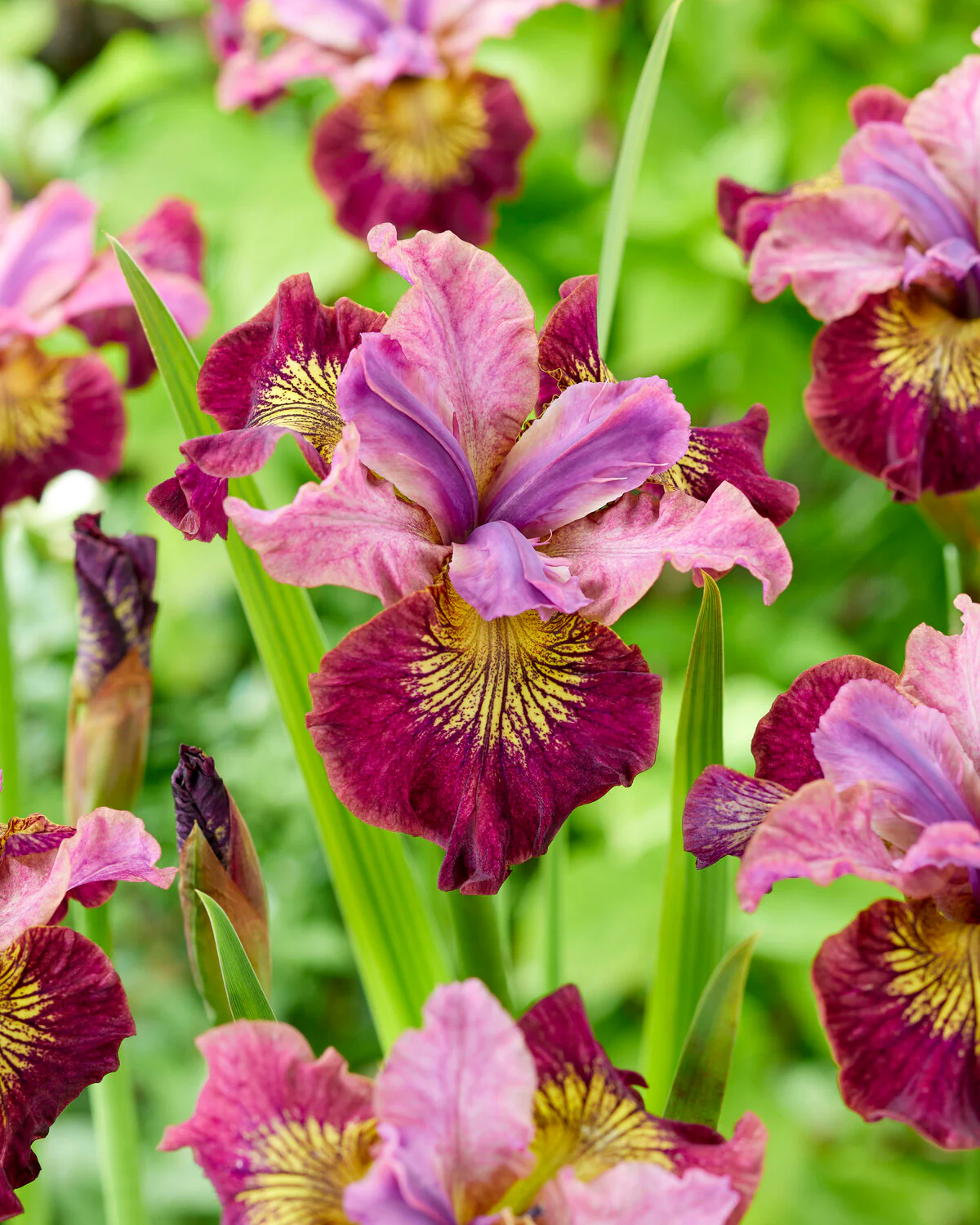
Iris 'Miss Apple'
If you are searching for an Iris to catch the eye—look no further. Iris sibirica 'Miss Apple' is superb, and has been delighting gardeners for more than 15 years. It produces stunning two-toned flowers, red-purple and pink etched with gold. In early summer, these blooms nestle snugly against the narrow, green, strap-like leaves. The main petals (or falls) of Iris 'Miss Apple' are as near to red as you’ll find in any iris bloom, while the yellow markings on some of the other falls are so large, they extend in broad swathes nearly to the edges. The blooms are held on strong, sturdy stems.
Iris 'Miss Apple' is a short-growing Siberian iris, at just around 65-75cm in height, so is perfect for the front of a border, or a patio container. Each stem carries two to five vibrant flowers, generally during the months of June and July. Iris sibirica 'Miss Apple' particularly likes a moist location, but do protect it from excessive winter wet and cold. If left undisturbed, it will naturalise and increase, year after year.
Original: $5.55
-70%$5.55
$1.66Product Information
Product Information
Shipping & Returns
Shipping & Returns
Description
If you are searching for an Iris to catch the eye—look no further. Iris sibirica 'Miss Apple' is superb, and has been delighting gardeners for more than 15 years. It produces stunning two-toned flowers, red-purple and pink etched with gold. In early summer, these blooms nestle snugly against the narrow, green, strap-like leaves. The main petals (or falls) of Iris 'Miss Apple' are as near to red as you’ll find in any iris bloom, while the yellow markings on some of the other falls are so large, they extend in broad swathes nearly to the edges. The blooms are held on strong, sturdy stems.
Iris 'Miss Apple' is a short-growing Siberian iris, at just around 65-75cm in height, so is perfect for the front of a border, or a patio container. Each stem carries two to five vibrant flowers, generally during the months of June and July. Iris sibirica 'Miss Apple' particularly likes a moist location, but do protect it from excessive winter wet and cold. If left undisturbed, it will naturalise and increase, year after year.